
The O'Hare Group develops catalysts and functional materials that close loops in the chemical economy: upgrading abundant small molecules, defossilising chemical manufacturing through electrification, and enabling more recyclable plastics and packaging. Our approach combines organometallic chemistry, solid-state materials and device-relevant testing to deliver scalable, lower-toxicity routes to fuels, chemicals and materials.
Abundant-element catalysis for small-molecule upgrading
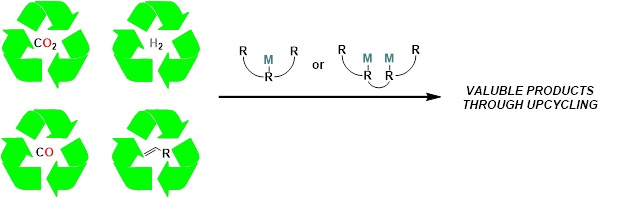
Modern decarbonisation demands chemistry that is cheaper, less toxic, and less resource-limited than precious-metal routes. We design d- and p-block catalysts and ligand environments that unlock new reactivity and selectivity for transformations of key industrial feedstocks (CO/CO2, H2, olefins), with emphasis on mechanism-led discovery and scalability.
Plastic waste to chemical feedstocks
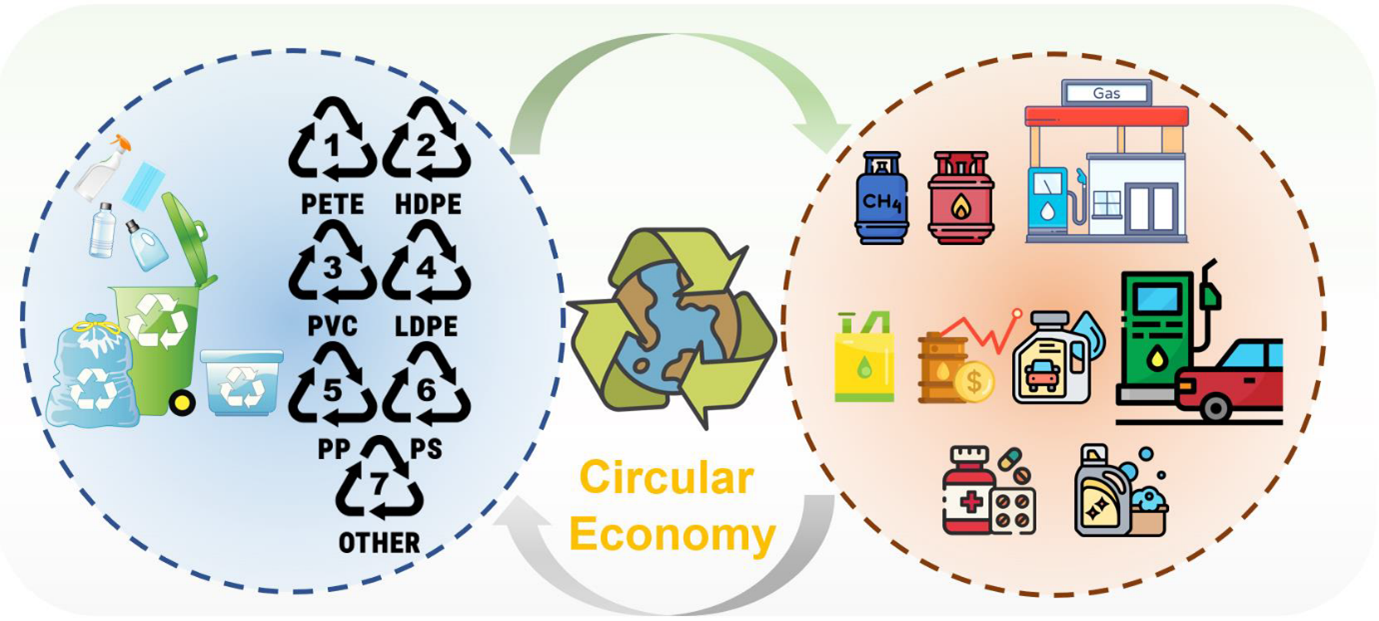
Plastics are essential but end-of-life management is failing at scale. We develop catalytic pathways for polyolefin upcycling, targeting higher-value chemical feedstocks with reduced energy input and carbon footprint.
Electrifying synthesis with renewable electrons
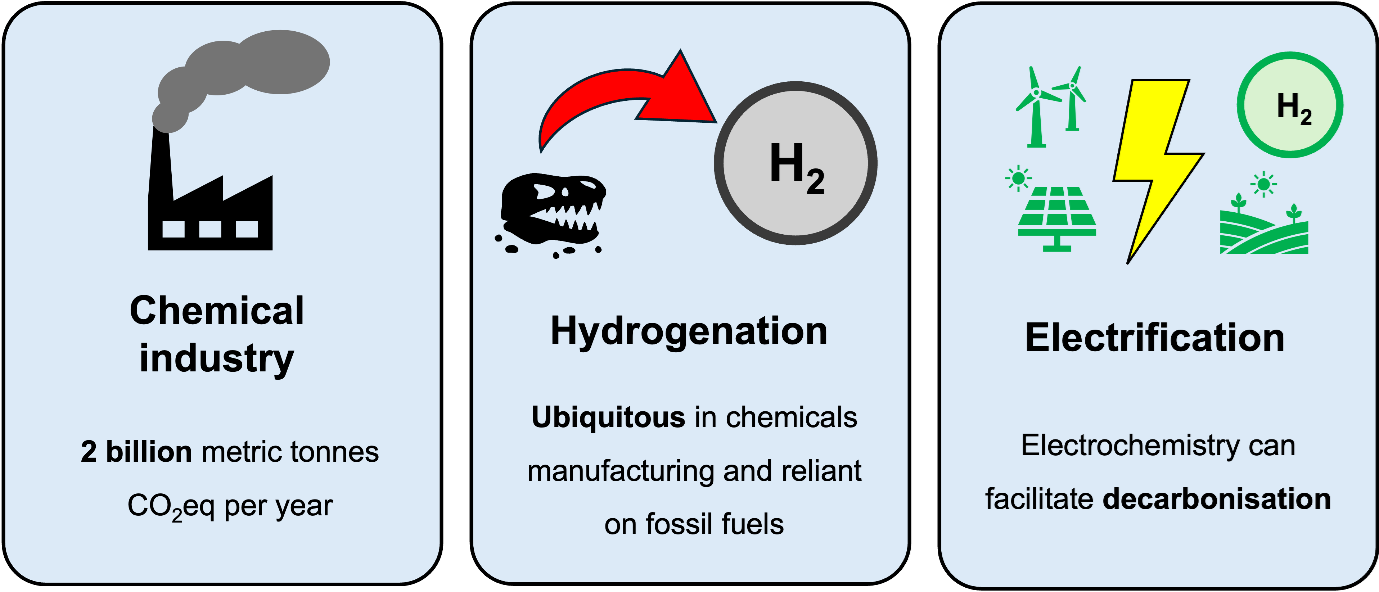
Green hydrogen and electrified chemical manufacture are central to net-zero systems, but key electrochemical steps remain limited by kinetics, selectivity and durability. We develop earth-abundant electrocatalysts for oxygen evolution and build modular electrochemical platforms (including flow architectures) for practical electrocatalytic hydrogenation using water as the hydrogen source.
Existing exemplars
Bio-oil hydrodeoxygenation (HDO): high-activity, stable HDO catalysts convert wood/bark-derived bio-oil fractions into liquid alkanes efficiently.
Recyclable high-barrier packaging: LDH nanosheet dispersions form transparent, robust barrier coatings that can replace metallised films and improve recyclability while delivering extremely low oxygen/water vapour transmission.
References (chronological)
-
Turner et al., Organometallics 2014, 33, 3891.
-
Buffet et al., J. Organomet. Chem. 2016, 801, 87.
-
Duan et al., Nat. Commun. 2017, 8, 591.
-
Diteepeng et al., Dalton Trans. 2019, 48, 16099.
-
Lamb et al., Dalton Trans. 2019, 48, 2510.
-
Duan et al., Nat. Catal. 2019, 2, 1078-1087.
-
Yu et al., Nat. Commun. 2019, 10, 2398.
-
Yu et al., ACS Appl. Mater. Interfaces 2020, 12(9), 10973-10982.Wang et al., ACS Sustainable Chem. Eng. 2025, 13, 9367-9369.
-
Evans et al., ACS Appl. Mater. Interfaces 2025, 17(23), 34592-34601.
-
Collins Rice et al., Ind. Chem. Mater. 2025, DOI: 10.1039/d4im00104d.
-
Yan et al., Chem. Sci. 2025, 16, 14646-14654.